What Is AI Visibility? Getting Discovered When Customers Ask AI
AI visibility is how often AI assistants recommend your business. What it means, how AEO and GEO fit in, and how to improve your odds of being the answer.
When someone asks ChatGPT, Claude, Gemini, Perplexity, or Grok "who's the best [what you do] near me," does your business get named?
AI visibility is how these systems see your business: when they recommend you, when they don't, and who they recommend instead. Put simply, it's how often the major AI assistants suggest you as the answer when someone describes a problem you solve.
It matters more every month, and the numbers move fast enough to make the point on their own. ChatGPT reaches 1.2 billion people each week (OpenAI, 2026). ChatGPT is still the largest assistant, but its share of AI prompt volume fell from 70% in January 2026 to 50% by June as Gemini rose from 17% to 30% and Claude from 2% to 11% (Comscore, 2026). Google's AI answers reach more than 2.5 billion people a month, and its conversational AI Mode passed a billion within a year of launching (Google, 2026). A growing share of your customers are asking an AI assistant instead of using search engines and scrolling through a page of blue links. If the AI chat response doesn't mention you, you never enter the conversation. And you rarely find out it happened. Closing that blind spot is exactly what our AI Visibility Analysis does.
Here's the reassuring part: none of this is magic, and it isn't a bag of new tricks. It runs on the same foundations as being found in ordinary search with some additional considerations. This guide covers what AI visibility is, why the shift to AI hasn't killed SEO, and what actually moves the needle for a small business.
What "AI visibility" means
A search engine hands you a list of links, ordered by rank of SEO performance for your specific query. An answer engine searches the web on your behalf and hands back one composed answer, usually naming a few specific businesses, products, or sources.
That difference is the whole game. Web search still happens underneath, but what reaches the person has changed, and it's the biggest change to how people find businesses since search settled into its current shape two decades ago.
And the answer is not just a rewrite of the familiar first page of results. Researchers at Ruhr University Bochum and the Max Planck Institute for Software Systems compared what generative AI search systems cite against Google's own rankings across 4,706 queries. More than half of the sources in Google's AI answers came from outside the organic top 10, over 40% from outside the top 100, and the standalone chat assistants they tested showed almost no overlap with Google's rankings at all (arXiv, 2026). Being the top result no longer means you're the answer, and not being the top result no longer means you're invisible. The AI is reading a wider web than the one the rankings show.
Recall the last time you ran a search in Google, Bing, or Brave (whatever your preferred engine). When the results landed, how far did you scroll before clicking? If you're like most of us, you never made it past the first few results, and page two might as well not exist. An AI running that same search reads dozens of results, pages two and three included, to find the niche answer you're looking for. This change is fundamental, and it's the first of those additional considerations we mentioned above.
AI visibility is about being one of the businesses that gets named, for the questions that matter to your customers. That's what discovery really means here: not being found for your own brand name, since people who already know you will find you anyway, but being found by someone who has the problem you solve and has never heard of you.
AI visibility, AEO, and GEO: the same idea by different names
You'll run into three labels for this, and they all point at the same goal:
- AEO stands for answer engine optimization: getting your business named in the answers AI assistants give.
- GEO stands for generative engine optimization: the same thing, framed around generative AI.
- AI visibility or AI search optimization: plain-language names for showing up in AI chat responses.
We use "AI visibility" because it says what it is in words a customer understands. When you see AEO or GEO elsewhere, read them as synonyms.
The key idea: the AI is doing the searching for you
This is the one idea that makes everything else click, and it's the part most people get wrong.
When you ask an AI assistant a question, it usually doesn't answer from memory. It runs live web searches on your behalf, often several of them, reads what comes back, and assembles an answer from what it finds. It's a research assistant doing the searching you used to do yourself, faster and across more queries at once.
Two things follow from that:
- The web still decides who can be named. An assistant can only recommend a business it can find, crawl, and understand on the open web. If it can't retrieve you, it can't cite you.
- One question becomes many searches. To answer "the best affordable accountant for a freelancer in Austin who files quarterly," the assistant breaks the request into several narrower searches and combines the results into a synthesized answer. The average AI-mode query is already about three times longer than a traditional search (Google, 2026), which means more detail to match against and more specific sub-questions to show up for. Those specific, lower-volume questions are what marketers call the long tail, and answering them is the next additional consideration in AI visibility.
So AI hasn't replaced search. It wrapped it. Underneath, the retrieval layer is still the open web.
Why SEO is still foundational
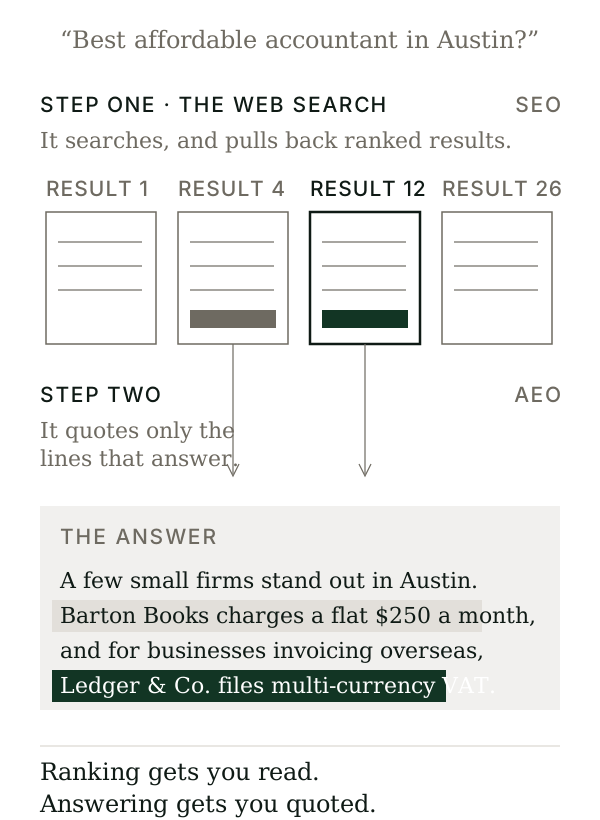
Because the assistant searches the web to answer, getting recommended happens in two stages. It helps to view them separately.
Stage one: getting into the net. Before an AI can mention you, its search step has to find and shortlist your page. Google confirms its AI answers work this way: they pull candidate pages from the regular Search index, then write the answer from what they find (Google Search Central). To make that shortlist, your page has to be crawlable, indexed, and good enough to earn a normal search listing. This stage is pure SEO. If classic search can't find you, no AI can recommend you.
Stage two: getting pulled from the net into the answer. Out of everything it shortlisted, the AI picks which pages to actually quote. This is the part most people miss, and it's where you can beat competitors with far bigger budgets.
A useful frame of reference, though not a measured statistic: SEO does the bulk of the work of getting you seen, and AEO is the smaller, decisive slice at the end. SEO gets you into the running. That last stretch decides who gets quoted.
One honest note, because the internet is full of the opposite advice: there's no separate AI trick. Google says plainly that you don't need special AI files (like an "llms.txt"), no new schema markup invented for AI, and no rewriting or chopping up of your content for machines (Google Search Central). A September 2026 scan found only 9.3% of the top 1,000 domains (and 8.3% of the top 10,000) serve a confirmed llms.txt or llms-full.txt (Rankability, 2026). Don't misread that as permission to skip structured data, though. Schema markup is still core SEO: Google's own guidance is to keep using it, because it earns rich results in regular search, and that search foundation is exactly what your AI visibility stands on. What it isn't is a shortcut. Most pages AI cites do carry schema markup, but that's because well-run sites tend to have both; one study that added markup to pages AI was already citing measured no further lift (Ahrefs, 2026). So do schema as the good SEO it is, and be suspicious of anyone selling a special AI version of it. The winners are the clearest, best answers on sites the web can read and trust.
What makes AI pick your page
If SEO gets you shortlisted, what makes an assistant quote you instead of the page below you? Two things, and both favor a focused small business.
Answer the specific question. An AI doesn't always just run one search. It breaks your customer's question into multiple narrower ones and picks the best source for each, a process Google calls "query fan-out." That's why pages nowhere near the top of search rankings still get cited in AI responses: for Google's AI answers, the share of citations coming from the top ten search results fell from about 76% to about 38% in eight months (Ahrefs, 2026), and the standalone assistants cite Google's top ten only about 12% of the time (Ahrefs, 2025). A page that's the best answer to a precise, long-tail question beats a page that outranks it for the broad term. That's your opening.
Be the most quotable answer. A controlled study on this found the biggest gains came from adding substance a model can lift directly: relevant quotations, concrete statistics, and cited sources, plus clear writing. Each of those raised a page's visibility in AI answers by roughly a quarter to two-fifths, while keyword stuffing did nothing and can even hurt (ACM, 2024). Say the useful thing directly. Back it with a real number or a source. Write it clearly enough to be lifted in one piece.
How to actually improve your AI visibility
None of this is exotic. It's strong fundamentals, done deliberately:
- Be findable. Make sure your key pages can be crawled and indexed, load quickly, and work on a phone. If a search engine can't reach a page, an assistant can't recommend it. And if your site draws its text with JavaScript after the visitor arrives, most assistants can't read it at all (see the note below).
A note on "server-side rendering," because it decides whether AI can read your site at all. Some websites send the browser a finished page: the words are right there in the HTML it delivers. Others send a nearly empty page plus JavaScript instructions, and the text gets assembled in your browser after you arrive. A person can't tell the difference. Crawlers can: an analysis of more than a billion AI crawler requests found that none of the major AI crawlers run JavaScript, with Google's the only exception (Vercel, 2024). If your text is built in the browser, most assistants fetch your page and see close to nothing.
"Server-side rendering" simply means the first kind: the words arrive in the page itself. A quick self-test: right-click your page, choose "View Page Source," and search for a sentence you can see on screen. If it isn't in there, ask your web developer about server-side rendering before anything else on this list.
- Answer the real question, clearly and early. Write pages that directly answer what your customers ask, in plain language, with the answer near the top. Clear, well-structured writing is what both people and assistants pull from.
- Show real experience and earn trust. Say who you are, show genuine first-hand knowledge of your field, and back claims with specifics. Trust is the quality Google says it weighs most heavily (Google Search Central).
- Earn genuine authority. Real mentions, reviews, and links from places your customers already trust help you get retrieved and recommended. Don't buy fake ones. That's spam, and it's the kind that gets caught.
- Use structured data for rich results. Marking up your pages helps you qualify for richer search listings. Do it as good SEO practice, not as an AI trick.
Notice what's missing from that list: no gaming, no keyword stuffing, no machine-only files. The businesses that win AI visibility are the ones that are genuinely the best, clearest answer, and easy for the web to read.
How to see where you stand
The hard part is that you can't see what AI says about you by asking it once. The answer changes by engine, by phrasing, and by day. Ask the same question twice and you may get two different sets of names. There's a name for this difference: traditional search is essentially deterministic, meaning the same query returns the same list. AI answers are stochastic, meaning each answer is generated fresh, so the names in it can change from one ask to the next.
Citations themselves do not last long either. Across 883,000 pages on seven AI engines, the median page loses half its citation share within 11 days of peaking, and 78% fall to half their peak within two weeks (through September 8, 2026) (Profound, 2026).
Google Search Console now has a dedicated generative AI performance report, rolled out to websites worldwide as of August 31, 2026. It shows how often your pages appear in AI Overviews, AI Mode, and Discover's AI features. It reports impressions, not clicks, and it only covers Google. It does not tell you what ChatGPT, Claude, Perplexity, or Grok say about you (Google, 2026).
That's what our AI Visibility Analysis is for. It asks the questions the way a real customer would: 25 realistic customer questions across ChatGPT, Claude, Gemini, Perplexity, and Grok, with live web search on. It shows you how often each one recommends you and which competitors it names instead. Then we analyze the full set of responses and hand you six prioritized insights, each with a concrete next action, so you know where to focus first. It turns "I wonder if AI mentions us" into a list you can act on.
Key takeaways
- AI visibility is how AI assistants see your business, and whether they name you when customers ask about what you sell.
- AEO and GEO are just other names for the same goal of AI visibility.
- Assistants answer by searching the web for you, so the open web still decides which sites are in the running.
- It happens in two stages: SEO gets your page into the AI's shortlist, and being the clearest, best-supported answer to the specific question gets you quoted. No magic files or schema tricks required.
- Small businesses win on the long tail, where the questions are specific enough to have a single best answer.