Is SEO Dead? Why Web Search Still Decides
No, SEO isn't dead, but there are new kids on the block: AEO and GEO. What AI search changed, what still works, and how SEO vs AEO really fits together.
A customer types "emergency plumber near me" into Google and gets a page of websites. SEO, short for search engine optimization, is the work of getting your site onto that results page, as close to the top as possible. In practice it means three things: a site Google can read and understand, pages of content that answer what people search for, and enough of a reputation that Google trusts you. Do it well and that customer clicks through to you instead of the plumber below you. For more than twenty years, that click has been the payoff.
Today the same customer can ask an AI assistant instead, and get an answer rather than a list of links: one or two plumbers, named, with reasons why they were selected. Google itself now writes an AI summary at the top of many results pages, and for some searches it now expands that summary into a full AI Mode-style answer in place, pushing the usual list of links further down (Search Engine Roundtable, 2026). People who see an AI summary click through to a website less often. Fewer clicks reach websites. If the click was the payoff, "Is SEO dead?" is a fair question.
The short answer, in 2026 as much as ever: no, SEO isn't dead. It's the foundation AI search runs on.
What's changing is real and worth understanding. But the people declaring SEO dead with the rise of AI have it backwards. Here's why, and what it means for where you spend your time.
Where the "SEO is dead" fear comes from
The fear isn't baseless. Fewer searches end in a click than they used to. In the first four months of 2026, about 68% of US Google searches ended without a single click, up from roughly 60% in 2024 (SparkToro, 2026). When Google shows an AI summary at the top of the page, people click a traditional result about 8% of the time, versus 15% when there's no summary (Pew, 2025). One study found AI answers cut the click-through rate of the top result by roughly a third (Ahrefs, 2025), and a follow-up a year later measured an even steeper drop (Ahrefs, 2026). On US desktop in July 2026, the #1 organic result's CTR was 9.69% when an AI Overview was present versus 20.02% across all SERPs, and 74.3% of those AIO SERPs sent no organic click at all (Advanced Web Ranking, 2026). Comscore measured AI Overviews on 39.4% of US Google desktop searches in June 2026, up from 25.8% in July 2025 (Comscore, 2026).
So yes: the classic prize of SEO, the click, and the visitor it brings, is getting smaller. If your whole strategy was "rank number one and collect the clicks," that strategy is under real pressure. That part is true.
Why SEO is not dead: AI search is still search
Here's what the "SEO is dead" crowd misses. When someone asks an AI assistant a question, it doesn't answer from thin air. It searches the web, reads what it finds, and builds an answer from real pages. (We go deep on this in how AI search really works.)
Which means the AI can only recommend a business it can find, crawl, and trust on the open web. Getting into the running takes the same things as ranking: a crawlable site, helpful content, and authority. Google is explicit that its AI features use the same core ranking and quality systems as regular Search (Google Search Central). The data agrees: nearly every AI Overview cites at least one page from the top of the search results, and higher-ranked pages are cited more often than lower-ranked ones (seoClarity, 2025).
SEO didn't die. It became the entry ticket to AI search. Whether your ticket is actually getting your website referenced in AI answers is measurable, and that's what our AI Visibility Analysis checks.
What's different when the AI does the searching for you
Think about how you search. You type a few words, scan the first handful of results, click one, maybe two, and almost never reach page two. The top few results collect most of the clicks, and the rest of the page fights over what's left. SEO was built around that behavior: win the top spot, win the click.
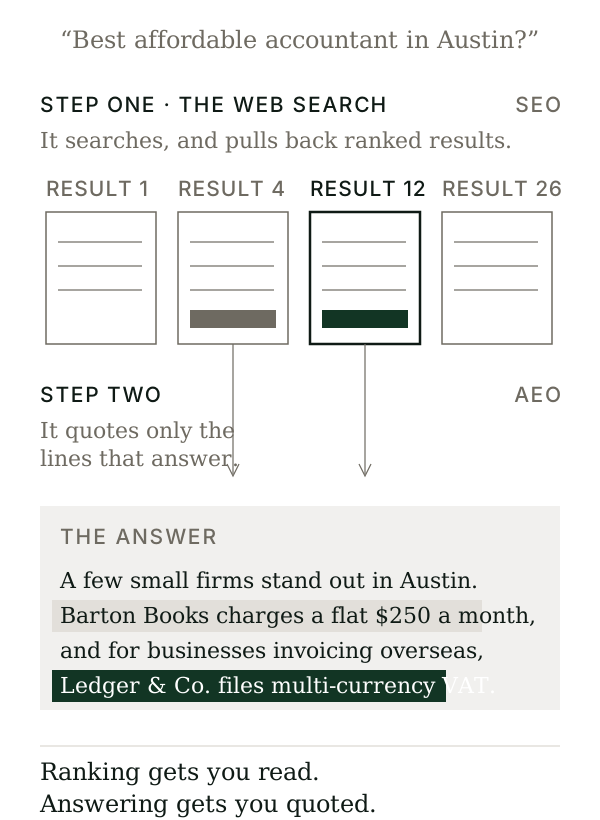
An AI assistant doesn't search like that. Give it the same question and it splits it into several narrower searches and runs them all at once. Google calls this query fan-out, "breaking down your question into subtopics and issuing a multitude of queries simultaneously on your behalf," and says it lets its AI "dive deeper into the web than a traditional search" (Google, 2025). Then it does the part no person has the patience for. It reads the pages that come back, dozens of them, not the titles. And because those searches are narrower than the question you asked, the pages it reads are often ones that don't rank anywhere near the top for the original question.
You can see this in what the AI ends up citing. Researchers at Ruhr University Bochum and the Max Planck Institute for Software Systems compared the sources in AI answers against Google's own rankings across 4,706 queries. More than half of the sources in Google's AI answers came from outside the organic top 10, over 40% from outside the top 100, and the standalone chat assistants overlapped with Google's rankings far less than that, one of them barely at all (arXiv, 2026). Most of those sources sit where no person scanning a results page would ever look.
So the ticket still matters. To be read at all, your page has to come up somewhere in the results those narrower searches pull back, and getting it there is SEO's job. But once you're in that net, your rank for the big keyword stops deciding much. The AI is choosing, out of dozens of pages it has actually read, the few that answer the specific question best. Getting chosen there is a different piece of work from getting ranked. That work has a name, AEO, and we untangle it from SEO below.
What actually changed: from winning the click to being referenced in an answer
The honest way to describe the shift: SEO has a new job, built on the same fundamentals.
- Old job: rank a page so a person clicks it.
- New job: be so findable, clear, and trusted that both people and AI assistants pull you into the answer.
The work that gets you there (a fast, crawlable site, content that genuinely answers real questions, and real authority) is the same work that's always been good SEO. You're not throwing anything away. You're pointing it at a different target.
The traffic that does arrive is worth more
There's a second half to the click story, and it's the encouraging one.
Shopify looked at its own storefront data for the second quarter of 2026. Visits arriving from AI assistants grew about three times year over year. Organic search visits grew 12%, on a much larger base. The more interesting number is what those visitors did once they arrived: shoppers referred by AI converted roughly 80% better than shoppers from organic search, and about twice as well in categories where people compare details before buying (Shopify, 2026).
Two honest caveats. That's Shopify's own data, so nobody outside Shopify can audit it, and it measures product purchases rather than service businesses. Treat the exact multiples as indicative. But the direction is what you'd expect: someone who arrives after an assistant has already answered their questions and named you is further along in making up their mind than someone who clicked a link to start looking. Fewer visitors but warmer visits.
The headline finding is the one that matters most here, though. Both channels grew. Similarweb's September 2026 ecommerce report finds that 89% of the time, consumers who use AI in shopping research also use search (Similarweb, 2026). Shopify's own read is that AI and organic search are doing different jobs, not competing for the same one, which is the same conclusion this article arrives at from the other direction. We take the money side apart properly in AI sends you less traffic. It's worth more.
AEO vs SEO: they are not rivals
Search either phrase, "AEO vs SEO" or "SEO vs AEO," and you'll find a fight. There isn't one. You'll hear AEO (answer engine optimization) and GEO (generative engine optimization) framed as the replacement for SEO. They're not a replacement. AEO sits on top of SEO. For the full picture, see what AI visibility is.
Here's the clean way to divide them. Getting recommended by AI happens in two stages. SEO gets your page into the net of results the AI casts when it searches. Then, out of that net, the AI decides which pages to actually pull into the answer, and that choice rewards the clearest, most specific, best-supported answer to the exact question. As a frame of reference, not a measured statistic: SEO is the bulk of the work, AEO is the smaller but decisive slice at the end.
There's no separate AEO switch to flip, though, and it's worth being precise about what that means. Google has said plainly that you don't need special AI files, special schema markup for AI, or your content chopped into tiny pieces for machines (Google Search Central). So there is no shortcut to buy, from us or anyone else. There is real work, though, and it's work SEO alone doesn't cover.
What AI visibility needs is its own strategy, because the second stage asks a question SEO never had to. SEO asks whether your page ranks for a keyword. AEO asks what happens when a customer describes their problem to an assistant: which businesses get named, in what words, and why not yours. A rankings report can't tell you. Asking an assistant once can't either, because the answer shifts by engine, by how the question is phrased, and by day. So the strategy starts with a picture of how AI currently talks about your market: the questions customers bring to it, how it describes businesses like yours, and which competitors it puts forward instead of you. Getting that picture is what our AI Visibility Analysis is for.
From there the work is specific. Write the page that squarely answers each question you're losing, with the answer near the top. Give it substance an assistant can lift whole: a real number, a named source, a plain sentence that says what you do and for whom. A controlled study of generative engines found that kind of substance raised a page's visibility in AI answers by roughly a quarter to two-fifths, while keyword tricks did nothing (ACM, 2024). Then look at what the competitors it names have that you don't: reviews, mentions on the sites the assistants read, a clearer statement of who they serve. None of that is a hack, and all of it is aimed at the AI's choice rather than a person's click. That's the part of the work SEO alone won't do for you.
Is local SEO dead, then?
No, and for local businesses the shift is friendlier than the headlines suggest. When someone asks an assistant for a plumber, a clinic, or a bakery near them, the assistant has to ground its answer in real-world signals: your address and hours, your reviews, your maps listing, the pages that say plainly where you work and what you do. That is local SEO, doing exactly what it has always done, for a new reader. In our experience running these analyses, the local businesses that get named are the ones whose services, location, and reviews say the same thing everywhere the web mentions them.
What to do now
If SEO isn't dead, where should you spend your time? One new step, then the fundamentals that serve traditional web search and AI at once:
- Get the AI picture first: which questions the assistants answer about your market, and who they name. Then write for the questions you're losing.
- Make your key pages crawlable, fast, and mobile-friendly.
- Answer the specific questions your customers actually ask, clearly and near the top of the page.
- Show real experience and earn genuine trust. Trust is the quality Google says it weighs most heavily (Google Search Central).
- Focus on the long tail, the specific questions where a focused business can be the best answer, instead of fighting national brands for the biggest head terms.
See where you stand
The one thing you can't do by hand is see what the AI assistants actually say about you today. That's what our AI Visibility Analysis does: it runs 25 realistic customer questions across ChatGPT, Claude, Gemini, Perplexity, and Grok, and shows how often each one recommends you, and who it names instead. It's the fastest way to find out whether your SEO foundation is translating into AI visibility.
Key takeaways
- SEO isn't dead. It's the foundation AI search runs on.
- The click is shrinking, so the goal shifts from winning the click to being named in the answer.
- AI assistants search the web to answer, so being findable and trusted still decides which websites make it into the pool they choose from.
- An AI can read dozens of pages per question, from far beyond the top results. Being in that net is SEO. Being the answer it picks out of the net is AEO.
- AEO and GEO sit on top of SEO. There's no separate AEO hack.
- AI sends fewer visits than search, but they arrive further along and convert better.
- Spend your time on fundamentals and the long tail (answering specific questions your customers are asking).