How AI Searches the Web, and How to Get Named in the Answers
Ask an AI a question and it runs the searches for you: one question fans out into many. How assistants search the web, pick sources, and decide who to name.
Ask Claude or Grok "what's a good [your service] in [your city]?" and an answer comes back in seconds, often naming a few specific businesses. Where did those names come from?
The short version: when you ask an AI assistant a question, it searches the web for you, reads the results, and builds an answer from what it finds. It's doing the searching you used to do yourself. Understanding how it chooses what to recommend is the difference between being in the answer and being invisible.
Here's what actually happens.
What happens when you ask an AI a question
Modern assistants like ChatGPT, Gemini, Perplexity, Claude, and Grok don't just recite memorized facts. For most real-world questions, they:
- Interpret your question and decide what information they need to seek out.
- Search the web, usually running several searches, not just one.
- Read and retrieve the most relevant pages.
- Synthesize an answer from those pages.
- Cite some of the sources they used.
Steps two and three are the ones that matter for your business. The AI assistant is querying the live web and pulling from real pages. If your page isn't among what it can find and trust, you're not in the answer. (Finding out whether you are is what our AI Visibility Analysis does.)
One question becomes many searches
People ask AI assistants long, specific questions, the kind nobody types into a search box. "A reliable, affordable bookkeeper for a one-person design studio that invoices internationally" is a single request. To answer it, the assistant breaks it into several searches and combines the results.
This is why the shift matters so much. The average AI-mode query is already about three times longer than a traditional search (Google, 2026). Each detailed question fans out into a spread of specific sub-searches, and your business needs to show up across that spread, not just for one keyword.
There's a second difference, and it compounds the first. A traditional search is one-directional: you type, the results appear, and the query is over. Whatever you do next is a new search, starting from zero. An AI assistant holds a conversation. Google describes AI Mode as giving people "the ability to go deeper through follow-up questions" (Google, 2025), and every major assistant works the same way: the answer comes back, and the person keeps going. "Which of those three is closest to me?" "Does the second one handle international invoicing?" "Any complaints about them?" Each follow-up is narrower than the last, and each one can send the assistant back to the web for another round of searches.
For your business, that changes what being found means. The conversation moves from a general question toward a decision, and the searches move with it: from "bookkeeper for a small design studio" to a check on one named firm's reviews. You can enter the conversation late, when a follow-up finally asks the specific thing your page answers best. You can also drop out of it, if that later search turns up nothing that backs you up. This is a different reader from a person on a results page. It searches, reads, remembers what it read, and keeps searching until the customer is ready to choose.
What is query fan-out?
Query fan-out is the technique where an assistant takes your one question, breaks it into several narrower searches, runs them all at once, and builds a single answer from the best source for each. The term comes from Google, which describes its AI Mode as "breaking down your question into subtopics and issuing a multitude of queries simultaneously on your behalf" (Google, 2025). The pattern holds across the major assistants.
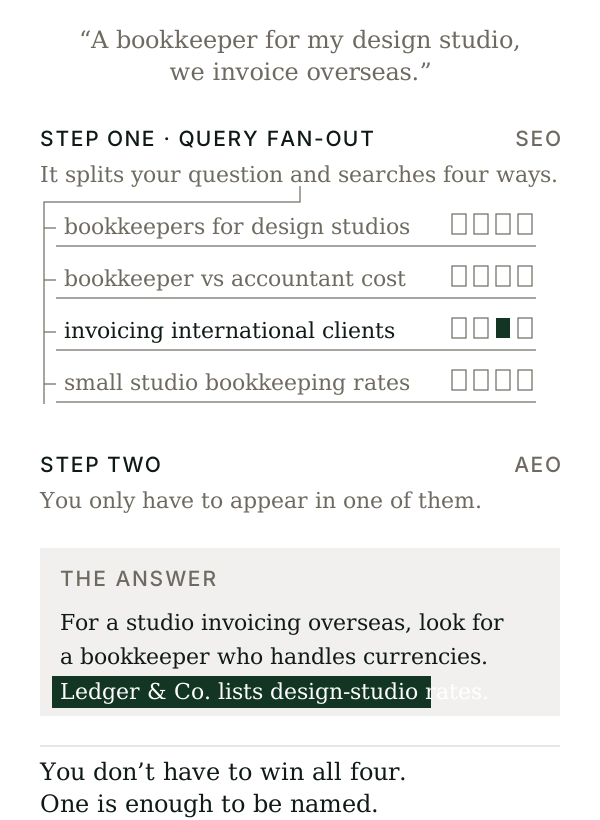
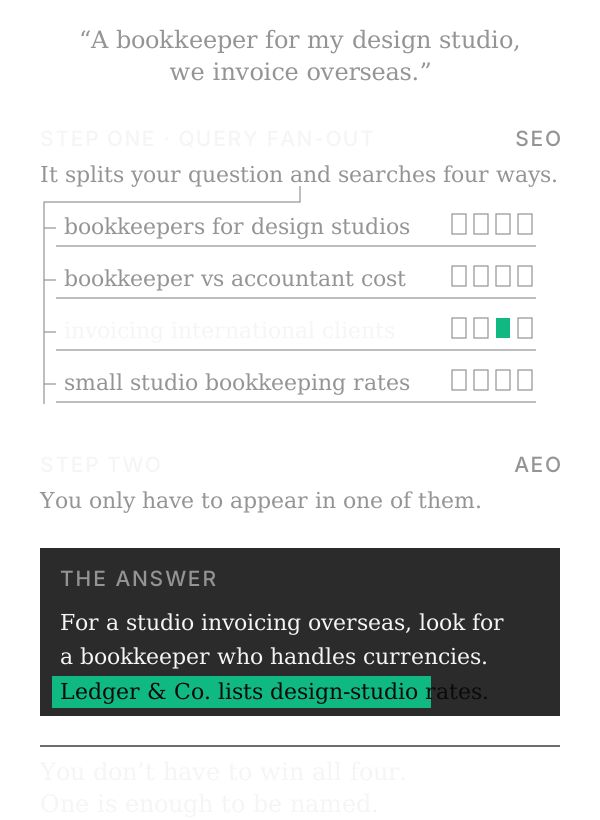
For your business, it means the searches that actually get run are the narrow ones. A page that squarely answers "do you service this neighborhood" or "does this work for my situation" competes in searches your homepage never enters. Write the page that answers the narrow question.
Why AI-run searches will outnumber human ones
Now add up what fan-out means at scale. More than 2.5 billion people a month see Google's AI answers, its conversational AI Mode passed a billion monthly users within a year of launch (Google, 2026), and ChatGPT reaches 1.2 billion people each week (OpenAI, 2026). Every one of those questions can fan out into several machine-run searches. One person asks. The assistant searches three, five, sometimes a dozen times.
Nobody publishes a count of machine-run versus human-typed searches, so read this as our reasoning, not a measured statistic: when billions of questions each trigger several searches, AI-run searches pass human ones, and the crossover happens quietly, because nobody sees the searches run on their behalf. Increasingly, the searcher your website needs to impress is software rather than a person: something deciding, in milliseconds, whether your page answers one narrow question better than anyone else's.
How the AI decides which sources to name
Assistants lean on the same signals as search for relevance, authority, and trust, with one important twist: they don't grab the top-ranked page and stop there. Because one question fans out into many specific sub-questions, the AI picks the best answer to each, and that's often not the highest-ranked result. For Google's AI answers, the share of citations coming from the top ten search results fell from about 76% to about 38% in eight months (Ahrefs, 2026).
The standalone assistants diverge even further: only about 12% of the URLs they cite rank in Google's top ten for the same question (Ahrefs, 2025).
An August 2026 snapshot across 11 AI platforms found the same split at a wider scale. No two platforms shared more than 24.1% of the pages they cited, and 55.2% of the top-10 AI citations were not in the classic top 10 (Rankability, 2026). Winning one assistant's shortlist is not the same as winning the others.
Rankings still matter: ranking gets you into the running. Being the clearest, best-supported answer to the specific question is what gets you quoted.
Why the open web still decides
Put it together and the conclusion is simple: AI sits on top of search rather than replacing it. The retrieval layer underneath is still the open web, still crawled, still judged on relevance and trust. An assistant can't recommend a business it can't find and understand. This is why SEO isn't dead. It's the foundation.
How to get your business into AI answers
To get pulled into AI answers:
- Be retrievable. Make sure your important pages can be crawled and indexed, and load fast.
- Answer the real questions clearly. Write pages that directly answer what customers ask, in plain language, with the answer near the top.
- Earn authority and trust. Genuine reviews, mentions, and links from trusted places help you get retrieved and named.
- Own the long tail. The questions people bring to assistants are long and specific (the average AI Mode search is triple the length of a traditional Search query, per Google, 2026), and each one fans out into narrower searches still. Those narrow questions are where a focused business can be the best answer, and, as the citation data above shows, the best answer gets named whether or not it ranks first.
For the bigger picture of what this adds up to, see what AI visibility is.
See what AI retrieves about you
You can't tell what the assistants pull about your business by asking once. It changes by engine, by phrasing, and by day. Our AI Visibility Analysis runs 25 realistic customer questions across all five major assistants with live web search on, and shows exactly how often each one recommends you and who it names instead.
Key takeaways
- When you ask an AI a question, it searches the web for you and builds an answer from real pages.
- One question becomes many specific searches, so you need to show up across a spread of queries.
- Assistants pick the best answer to each specific sub-question, which is why pages that don't rank at the very top still get cited.
- The open web still decides who gets recommended, which is why fundamentals and authority matter.
- The searcher to impress is increasingly the AI itself: machine-run searches are on their way to outnumbering human ones.